
Convert VTT subtitles to SRT without uploading your files. Paste the subtitle text or drop a .vtt file, and the SRT version appears instantly — every cue keeps its exact start and end time. Copy the result or download it as a .srt file.
VTT (WebVTT) is the web's subtitle format — the one browsers and HTML5 video players read. SRT (SubRip) is the older plain-text format almost every desktop player, DVD player, and editor understands. If the video needs styling instead, VTT to ASS adds fonts and colors, and SRT to VTT runs the trip in reverse.
How to use
- Paste your VTT subtitles into the input box, or drop a .vtt file to load it.
- The SRT output appears automatically, with every cue's timing preserved to the millisecond.
- Copy the result, or download it as a .srt file with the Download button.
- Check the first and last cues in your player — if the timing looks right there, the whole file is right.
Why use Toolsvine
WebVTT is the format the web hands you, and SRT is the format everything else plays — but most converters between them want the file uploaded first, which is an odd ask for subtitles you wrote yourself. This converter runs locally in your browser, drops the WEBVTT header, renumbers the cues in order, and keeps every timing to the millisecond.
What is VTT, and what is SRT?
VTT and SRT are both plain-text subtitle formats built from the same idea: cues with a start time, an end time, and one or two lines of text. VTT is the web-native format that browsers and HTML5 video read, and SRT is the older format that desktop players, DVD players, and editors have read for decades.
The two formats differ in small ways that matter. VTT files start with the line WEBVTT, timestamps use a dot (00:00:01.000), and cue numbers are optional — many VTT files have none at all. SRT needs numbered cues and timestamps with a comma (00:00:01,000), so this converter adds the numbers, swaps the dots for commas, and drops the header.
What changes in the conversion
| Detail | SRT |
|---|---|
| Header | WEBVTT line removed |
| Timestamps | Dot becomes a comma: 00:00:01.000 → 00:00:01,000 |
| Cue numbers | Added, in order |
| Text | Unchanged |
| Timings | Unchanged, to the millisecond |
VTT files often carry extra features SRT cannot hold: positioning settings after the timestamp, voice spans, and style blocks. Those are dropped, because SRT has nowhere to put them — the words and the times carry over, and everything else is left behind. If styling matters, convert to ASS instead, which keeps it.
Worked example: two VTT cues become SRT
Press Sample and the tool loads two cues: "Hello world" from 1 second to 4.5 seconds, and "Second line here" from 5 seconds to 7.25 seconds. The conversion changes three things and nothing else: the WEBVTT header goes away, every dot in a timestamp becomes a comma, and the cues gain numbers in order.
Example input:
WEBVTT\n\n00:00:01.000 --> 00:00:04.500\nHello world\n\n00:00:05.000 --> 00:00:07.250\nSecond line here
Becomes:
1\n00:00:01,000 --> 00:00:04,500\nHello world\n\n2\n00:00:05,000 --> 00:00:07,250\nSecond line here
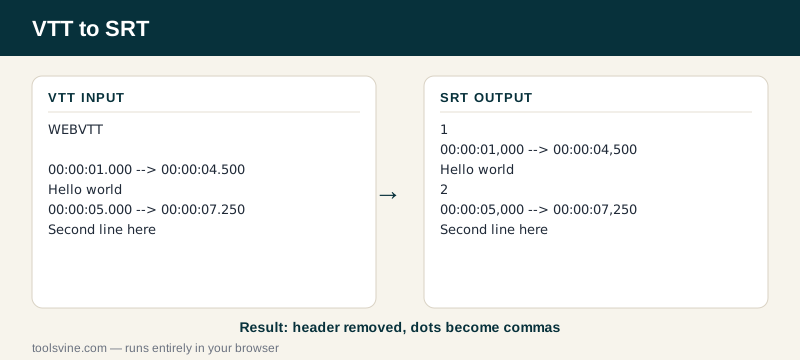
Try it yourself: change the second cue's end time from 7.25 to 8 seconds in the VTT and watch the SRT update — 00:00:08,000, with the comma. Then open the .srt file in VLC: the subtitles play exactly as they did from the VTT, which is the point — the words and the times never moved. If the video goes to YouTube instead, the VTT to SBV converter writes the format YouTube's uploader expects.
Where does SRT work?
SRT works almost everywhere subtitles play: VLC, MPC-HC, and most desktop players, DVD and Blu-ray players, older TVs, video editors, and YouTube's uploader. It is the safest format to hand to a stranger's player, because nearly everything written in the last twenty years reads it.
The one place SRT does not belong is a web page: browsers read VTT natively and ignore SRT, so keep the VTT for the web and convert a copy to SRT for everything else. The two formats hold the same words and times, so a round trip loses nothing but the VTT-only extras.
Frequently asked questions
Will the subtitle timings stay exact when converting VTT to SRT?
Yes — timings are carried over to the millisecond, and only the timestamp format changes: dots become commas. The moments each line appears and disappears do not move at all. Because VTT and SRT both store time the same way, the conversion is lossless — a round trip from VTT to SRT and back gives you the same timings you started with.
Is converting VTT to SRT free?
Yes, completely free with no account and no file-size games. The conversion runs in your browser, so your subtitles never leave your device. You can convert one cue or a two-hour feature film's worth of subtitles and the price stays the same: nothing.
Can I upload a .vtt file instead of pasting?
Yes — drop the file on the box above and its text loads into the input automatically. You can also paste from your clipboard, which is handy for subtitles copied out of an editor. Either way, the file is read on your device and never uploaded anywhere.
What if my VTT file has errors?
The tool shows a plain-English error naming the problem — for example a cue with a missing timestamp — instead of producing a broken file. Fix that cue and the conversion runs. Blank cues and cues that end before they start are dropped quietly, since they cannot play anyway.
What happens to VTT styling and positioning?
It is dropped, because SRT has nowhere to put it. VTT can carry voice spans, bold and italic tags, positioning settings after the timestamp, and whole style blocks — SRT holds only words and times. The cues, the words, and the timings all survive the conversion. If the styling matters, convert to ASS instead: it keeps fonts, colors, and position.