
Need to turn binary into decimal? This free binary to decimal converter converts the moment you type — no upload, no sign-up, and nothing leaves your browser. Paste or type a value, and the result appears instantly along with a count of how many digits went in.
The conversion runs entirely on your device, so even long values stay private. It uses exact BigInt math for numeric conversions, so big inputs stay precise. To go the other way, try the Binary to Hexadecimal Converter, or see the same value in another base with the Binary to Octal Converter.
How to use
- Type or paste your binary value into the input box above — only the digits 0 and 1 are allowed.
- The decimal result converts instantly — for an empty box, check the message under the tool.
- Use Copy result to copy the output, or Clear to start over with a new value.
Why use Toolsvine
Online converters usually use ordinary floating-point numbers, which silently lose precision past 53 bits — exactly where cryptographic keys and hashes live. Toolsvine uses BigInt, so the decimal you get is the true value, digit for digit, for any length of input. It is free, needs no account, and works offline once the page has loaded.
How does binary become decimal?
Each binary digit is worth a power of two, counting from the right starting at 2 to the power of 0, which is 1. Add up the positions that hold a 1, and you have the decimal value. For 1011, the 1s sit at 2⁰, 2¹ and 2³, so 1 + 2 + 8 = 11. The formula is simply the sum of 2ⁿ for every position n that holds a 1 — no division, no lookup tables.
That place-value idea is the same one decimal uses, only with powers of two instead of powers of ten. Once you see it, any binary number becomes a short addition problem, and the tool does the addition for you instantly, even for values hundreds of digits long.
Worked example: 10101010 becomes 170
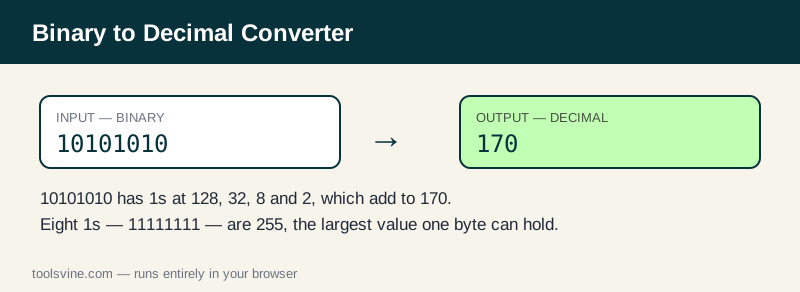
Take 10101010. From the right, the positions are worth 1, 2, 4, 8, 16, 32, 64 and 128. The 1s are at 128, 32, 8 and 2, which add to 170. The same method works for any length: 110101 is 1 + 4 + 16 + 32 = 53, and eight 1s — 11111111 — are 255, the largest value one byte can hold.
| Binary | Decimal | Why |
|---|---|---|
| 0 | 0 | Zero stays zero in every base. |
| 1 | 1 | One is one in binary too. |
| 10 | 2 | One 2, no 1s. |
| 101 | 5 | 4 + 1. |
| 1111 | 15 | 8 + 4 + 2 + 1. |
| 101010 | 42 | 32 + 8 + 2. |
| 11111111 | 255 | The largest 8-bit value. |
255 is a familiar boundary: eight 1s make the largest value one byte can hold. Nine bits reach 511, sixteen bits reach 65,535, and thirty-two bits reach 4,294,967,295 — the classic limits of computing, and the reason IP addresses and memory sizes cluster around those numbers.
Why do long binary numbers need BigInt?
JavaScript's ordinary numbers are 64-bit floats, which can only represent integers exactly up to 2⁵³ — about 9 quadrillion. Past that, the last digits silently round off, so a 256-bit cryptographic key would convert to a decimal that looks right but is wrong in its final digits. BigInt is JavaScript's exact integer type: it stores every digit, so the decimal it produces for a 200-digit binary value is the true value, digit for digit.
Frequently asked questions
How do I convert binary to decimal by hand?
Write the powers of two under the digits, starting with 1 on the right: 1, 2, 4, 8, 16, 32, and so on. Add up the powers under each 1 and ignore the 0s. For example, 10101010 has 1s at 128, 32, 8 and 2, which add to 170.
Is my input uploaded anywhere?
No. The conversion runs entirely in your browser with JavaScript. Your value never leaves your device, and the tool keeps working if you go offline after the page loads, so private keys and test data stay private at any stage of the process.
What happens if I paste something invalid?
The tool shows a plain-language message under the input instead of crashing or guessing. Fix the highlighted problem — a stray 2, a letter, or a decimal point — and the result updates. Only the digits 0 and 1 are allowed in a binary number.
Can I convert very long binary numbers?
Yes — the converter uses BigInt, so it handles numbers far larger than JavaScript's normal safe-integer limit of about 9 quadrillion. Paste a 200-digit binary value and you still get an exact decimal result, digit for digit, with no rounding or truncation.
What is the largest 8-bit binary number?
11111111, which is 255 in decimal. Eight bits hold 256 values, from 0 to 255, which is why 255 appears everywhere in computing — color channels, subnet masks, and the maximum value of a single byte all top out at 255.