
Need to turn octal into decimal? This free octal to decimal converter converts the moment you type — no upload, no sign-up, and nothing leaves your browser. Paste or type a value, and the result appears instantly along with a count of how many digits went in.
The conversion runs entirely on your device, so even long values stay private. It uses exact BigInt math for numeric conversions, so big inputs stay precise. To go the other way, try the Octal to Binary Converter, or see the same value in hex with the Octal to Hexadecimal Converter.
How to use
- Type or paste your octal value into the input box above — only the digits 0 to 7 are allowed.
- The decimal result converts instantly — for an empty box, check the message under the tool.
- Use Copy result to copy the output, or Clear to start over with a new value.
Why use Toolsvine
A converter that rounds long values is dangerous when the number is a permission mask or a memory address. Toolsvine uses BigInt, so the decimal you get is exact for any length of input, and it appears as you type — no button, no upload, no account. The place-value method it uses is the one taught in textbooks, so the answer is easy to check by hand.
How does octal become decimal?
Each octal digit is worth a power of eight, counting from the right starting at 8 to the power of 0, which is 1. Multiply each digit by its place value and add them up. For 326: 3 × 64 + 2 × 8 + 6 × 1 = 192 + 16 + 6 = 214. That place-value idea is the same one decimal uses, only with powers of eight instead of powers of ten.
Notice that octal 10 is decimal 8, octal 100 is decimal 64, and octal 1000 is decimal 512. Each extra digit multiplies the value by eight, just as each extra decimal digit multiplies by ten — the reason octal numbers look small for their value and why a three-digit permission like 755 is a much larger decimal number than it appears.
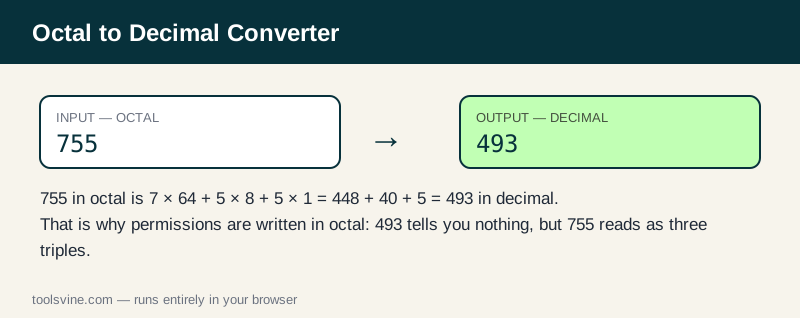
Worked example: the permission 755 is 493
Take the permission 755. From the right: 5 × 1 + 5 × 8 + 7 × 64 = 5 + 40 + 448 = 493. So the familiar 755 is decimal 493 — a number that tells you nothing at a glance, which is exactly why octal is used for permissions instead. The same method gives 777 as 511 and 644 as 420.
| Octal | Decimal | Why |
|---|---|---|
| 0 | 0 | Zero stays zero in every base. |
| 7 | 7 | A single digit is itself. |
| 10 | 8 | One eight, no ones. |
| 17 | 15 | 8 + 7. |
| 100 | 64 | One sixty-four. |
| 755 | 493 | 448 + 40 + 5. |
| 777 | 511 | The largest 9-bit value. |
777 is the largest value nine bits can hold — 511 — which is why a file with permissions 777 is fully open to everyone. Try the worked example in the tool: paste 755 and you should see 493 immediately, along with a digit count.
Why do programmers still use octal?
Octal survives because it is the most readable way to write three-bit groups, and Unix permissions are exactly three-bit groups. A decimal permission of 493 means nothing to a developer, but 755 reads as three permission triples at a glance. Octal also appears in embedded systems and in C escape sequences. When the same value needs to be binary, the Binary to Decimal Converter shows the same place-value math in base 2.
Frequently asked questions
How do I convert octal to decimal by hand?
Multiply each digit by its place value, counting powers of eight from the right: 1, 8, 64, 512. For example, 755 is 7 × 64 + 5 × 8 + 5 × 1, which is 448 + 40 + 5 = 493. Add the products and you have the decimal value.
Is my input uploaded anywhere?
No. The conversion runs entirely in your browser with JavaScript. Your value never leaves your device, and the tool keeps working if you go offline after the page loads, so private keys and test data stay private at any stage of the process.
What happens if I paste something invalid?
The tool shows a plain-language message under the input instead of crashing or guessing. Fix the highlighted problem — a digit 8 or 9, a letter, or a decimal point — and the result updates. Only the digits 0 through 7 are allowed in octal.
Can I convert large octal numbers?
Yes — the converter uses BigInt, so it handles numbers far larger than JavaScript's normal safe-integer limit of about 9 quadrillion. Paste a long octal value and you still get an exact decimal result, digit for digit, with no rounding.
What does octal 777 mean in file permissions?
It means read, write, and execute for everyone: owner, group, and others each get all three permissions. In decimal that is 511, which is why nobody writes permissions in decimal — 777 shows the three permission triples at a glance, and 511 hides them completely.