
Need to turn binary into hex? This free binary to hexadecimal converter converts the moment you type — no upload, no sign-up, and nothing leaves your browser. Paste or type a value, and the result appears instantly along with a count of how many digits went in.
The conversion runs entirely on your device, so even long values stay private. It uses exact BigInt math for numeric conversions, so big inputs stay precise. To go the other way, try the Binary to Decimal Converter, or decode a payload that hides encoded values with the Base64 Encoder.
How to use
- Type or paste your binary value into the input box above — only the digits 0 and 1 are allowed.
- The hexadecimal result converts instantly — for an empty box, check the message under the tool.
- Use Copy result to copy the output, or Clear to start over with a new value.
Why use Toolsvine
Hex is how developers actually read binary data, and a converter that rounds or truncates long values is worse than useless. Toolsvine uses BigInt, so a 256-bit value converts exactly, and the result appears the moment you type — no button, no upload, no account. The grouping method it uses is the same one in every textbook, so the answer is easy to check by hand.
How does binary become hexadecimal?
Hexadecimal is base 16, so each hex digit holds exactly four binary digits — because 16 is 2 to the power of 4. Split the binary number into groups of four from the right, pad the leftmost group with zeroes, then read each group as one hex digit: 0000 is 0, 1010 is A, 1111 is F. The grouping is the whole method, and it works for any length.
That four-to-one mapping is why hex won over octal: a byte is exactly two hex digits, so FF is 255, 00 is 0, and a color like #1E7A4C is three bytes — red 30, green 122, blue 76. Hex is the shorthand developers actually read when they look at memory dumps, hashes, and network packets.
Worked example: 11111011 becomes FB
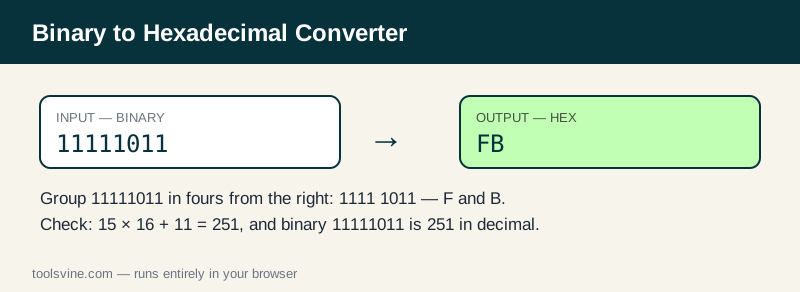
Take 11111011. Grouped in fours from the right: 1111 1011. The first group is 15, which is F; the second is 11, which is B — so the hex value is FB. Check it against decimal: 11111011 is 251, and 15 × 16 + 11 = 240 + 11 = 251. The numbers agree. A longer one works the same way: 111010110111100110100010101 groups as 0111 0101 1011 1100 1101 0001 0101, which reads as 75BCD15.
| Binary group | Hex digit |
|---|---|
| 0000–1001 | 0–9 |
| 1010 | A (10) |
| 1011 | B (11) |
| 1100 | C (12) |
| 1101 | D (13) |
| 1110 | E (14) |
| 1111 | F (15) |
Try the worked example in the tool: paste 11111011 and you should see FB immediately, along with a digit count. Spaces around the input are ignored, so pasting a grouped value like 1111 1011 works too.
Why is hex the language of developers?
Hex is compact enough to read and exact enough to trust: a 32-bit memory address fits in eight hex digits, a SHA-256 hash in sixty-four, and a color in six. Every debugger, packet sniffer, and hex editor prints in hex for that reason. When the same value needs to be text, the Octal to Hexadecimal Converter shows it from the octal side, and the base64 tools handle the encoded payloads hex often travels with.
Frequently asked questions
How do I convert binary to hex by hand?
Split the binary digits into groups of four, starting from the right, and pad the leftmost group with leading zeroes if it is short. Read each group as one hex digit: 1010 is A, 1111 is F. For example, 11111011 groups as 1111 1011, which reads as FB.
Is my input uploaded anywhere?
No. The conversion runs entirely in your browser with JavaScript. Your value never leaves your device, and the tool keeps working if you go offline after the page loads, so private keys and test data stay private at any stage of the process.
What happens if I paste something invalid?
The tool shows a plain-language message under the input instead of crashing or guessing. Fix the highlighted problem — a stray 2, a letter, or a decimal point — and the result updates. Only the digits 0 and 1 are allowed in a binary number.
Can I convert large binary numbers to hex?
Yes — the converter uses BigInt, so it handles numbers far larger than JavaScript's normal safe-integer limit of about 9 quadrillion. Paste a 256-bit binary value, like a hash, and you still get an exact hex result, digit for digit, with no rounding.
Why does 10 become A in hexadecimal?
Because hexadecimal is base 16, so it needs digits for the values 10 through 15, and it borrows the letters A through F for them. A is 10, B is 11, C is 12, D is 13, E is 14, and F is 15 — after F comes 10, which is 16.