
Will a general reader actually understand your page? This free readability score checker runs the classic Flesch formulas on your text and tells you its Reading Ease score and the US school grade needed to follow it — the same scores editors and SEO tools use.
Scoring happens entirely in your browser, so your draft never leaves your device. Check the length first with the Word Counter, then use the Sentence Counter to find the long sentences dragging your score down.
How to use
- Paste or type your text into the box above.
- Read your Flesch Reading Ease score, grade level and plain-English verdict.
- Use Copy result to copy the scores, or Clear to start over.
Why use Toolsvine
Readability is not dumbing down — it is removing friction so more people finish what you wrote. This checker gives you the honest Flesch numbers for your own text, with the formulas shown, so you can improve a page instead of guessing at it. Shorter sentences and plainer words are the only two levers, and the score tells you which one to pull first.
What is a readability score?
A readability score measures how easy a passage is to read, using two classic formulas. Flesch Reading Ease runs from 0 to 100, and higher is easier; the Flesch–Kincaid Grade Level estimates the US school grade needed to understand the text. Both use the same two inputs: average sentence length and average syllables per word.
The formulas are public and unchanged since the 1940s, which is why editors, teachers and SEO tools all report the same numbers for the same text. Reading Ease = 206.835 − 1.015 × (words ÷ sentences) − 84.6 × (syllables ÷ words). Grade Level = 0.39 × (words ÷ sentences) + 11.8 × (syllables ÷ words) − 15.59.
What the scores mean
| Reading Ease | Grade | Who can read it |
|---|---|---|
| 90–100 | 5th grade | Very easy — young readers |
| 80–90 | 6th grade | Easy — most adults |
| 70–80 | 7th grade | Fairly easy |
| 60–70 | 8th–9th grade | Plain English |
| 50–60 | 10th–12th grade | Fairly difficult |
| 30–50 | College | Difficult |
| 0–30 | College graduate | Very difficult |
How syllables are counted
Syllables are estimated by counting groups of vowels in each word, with adjustments for a silent final “e” and common endings. It is an approximation: words like “business” or “different” can be miscounted by one syllable, so treat scores as a guide, not a verdict. Aim for Reading Ease above 60 for general web readers.
Worked example: a library paragraph
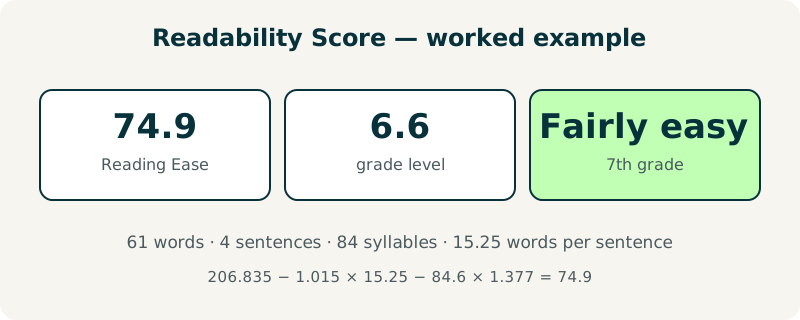
Paste this short paragraph about a city library and the checker reports 61 words, 4 sentences and 84 syllables — 15.25 words per sentence and 1.38 syllables per word. Plugged into the formulas, Reading Ease is 206.835 − 1.015 × 15.25 − 84.6 × 1.377, which is 206.835 − 15.48 − 116.50 = 74.9.
The grade level is 0.39 × 15.25 + 11.8 × 1.377 − 15.59, which is 5.95 + 16.25 − 15.59 = 6.6. “The city library opens its doors at nine every morning. Families walk in with children, students carry heavy books, and older readers settle into the quiet chairs by the tall windows. A good library is more than shelves of books. It is a place where anyone can learn a new skill, borrow a film, or simply sit and read in peace.” A score of 74.9 is “Fairly easy — 7th grade”, which is exactly where general web writing should sit.
A harder passage shows the contrast. A 49-word paragraph about photosynthesis, with 3 sentences and 84 syllables, scores Reading Ease 45.2 and grade level 11.0 — “Difficult, college level” — because its sentences average 16.33 words and its words average 1.71 syllables. Same syllable total, very different reading experience, and the formulas catch it.
How do I improve a low readability score?
Shorten your longest sentences and swap long words for shorter ones, because those are the only two inputs the formulas use. Cutting average sentence length below 20 words is usually the fastest fix: split any sentence over 30 words in half, replace “utilize” with “use” and “approximately” with “about”, then re-check the score.
Do not chase a perfect score. A grade level of 5 on a legal contract would be inaccurate, and a grade of 12 on a children's story would be unreadable. Aim for the band your readers expect — 60–70 for general web pages — and confirm the sentences are actually shorter with the Sentence Counter before you publish.
Frequently asked questions
Is my text uploaded anywhere?
No. The scoring runs entirely in your browser with JavaScript. Your text never leaves your device, and the tool works offline once the page has loaded. That makes it safe for unpublished drafts, school essays and client copy that you would never paste into a stranger's server.
What is a good Flesch Reading Ease score?
For general web readers, aim for 60–70 or higher — plain English that most adults read comfortably. News sites usually sit around 60–70; academic papers often fall below 30. A score of 74.9, like the library paragraph in the worked example, is fairly easy and suitable for a broad audience.
What does the grade level mean?
It estimates the US school grade needed to understand the text. Grade 8 means an average 13–14-year-old can follow it; grade 12 means a high-school graduate level. A grade of 6.6 means a typical sixth grader can read it, which is comfortable for most adult readers and standard for general web content.
How accurate is the syllable count?
It is an estimate. The counter counts vowel groups and adjusts for silent “e” and common endings, but irregular words can be off by one syllable, which moves the score by a point or two. Short passages are noisier than long ones, so score at least 100 words for a stable reading and treat a single point as meaningless.
How do I improve a low score?
Shorten your longest sentences and swap long words for shorter ones. Cutting average sentence length below 20 words is usually the fastest fix. Replace “utilize” with “use”, “approximately” with “about”, and break any sentence over 30 words in half, then paste the result back here to confirm the score moved.