
Writing a speech, a video script or a blog post with a time limit? This free reading time calculator tells you how long your text takes to read silently and how long it takes to say out loud, so you can cut or expand before you record.
Everything is calculated in your browser — your draft never leaves your device. For the full breakdown of the same text, try the Word Counter, and check whether it is easy to follow with the Readability Score Checker.
How to use
- Paste or type your text into the box above.
- Read the reading time and the speaking time, which update live.
- Use Copy result to copy a one-line summary, or Clear to start over.
Why use Toolsvine
Time is the limit that matters for speeches, videos and audiobooks, and word counts alone do not tell you it. This calculator turns your words into minutes using the two standard speeds — reading and speaking — so you know before you start whether your script fits the slot. The speaking figure is the one most people forget, and it is the one that keeps a talk on schedule.
How is reading time calculated?
Reading time divides your word count by 200 words per minute, the standard estimate for an average adult reading silently. Speaking time divides by 130 words per minute, the usual pace for clear spoken delivery. A 1,300-word script therefore reads in about six and a half minutes but takes ten minutes to speak.
The two figures are estimates for average text, not stopwatch measurements. Dense or technical material reads and speaks more slowly, and your personal pace may differ by 10–20% from the standard speeds. The calculator rounds its answers to whole seconds, so a short passage shows seconds and a long one shows minutes and seconds.
Why speaking is slower
Speaking needs breaths, pauses and emphasis, and listeners cannot re-read a sentence they missed. Presenters who plan on reading speed almost always overrun. Planning on speaking speed — and rehearsing once — is how talks finish on time.
Quick reference
| Words | Reading time | Speaking time |
|---|---|---|
| 200 | 1 min | 1 min 32 sec |
| 650 | 3 min 15 sec | 5 min |
| 1,300 | 6 min 30 sec | 10 min |
| 2,600 | 13 min | 20 min |
| 5,000 | 25 min | 38 min 28 sec |
These are estimates for average text. Dense or technical material reads and speaks more slowly, so treat the figures as a guide and rehearse anything that has a hard deadline.
Worked example: a 1,300-word script
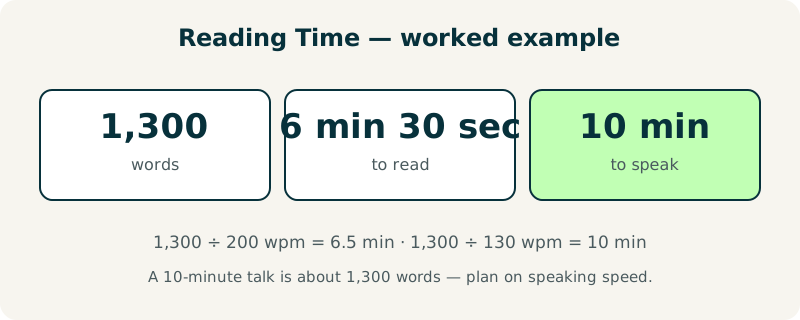
A script of 1,300 words takes 6 minutes 30 seconds to read silently and 10 minutes to speak aloud. The reading figure comes from dividing 1,300 by 200 words per minute, which is 6.5 minutes; the speaking figure comes from dividing 1,300 by 130 words per minute, which is exactly 10 minutes.
That gap is the whole point of the tool: a 10-minute talk is roughly 1,300 words, while a 5-minute talk is roughly 650 words. If you plan a 10-minute talk on reading speed, you will write about 2,000 words — and you will overrun by more than five minutes when you actually deliver it.
What mistakes should I avoid when timing a text?
The most common mistake is using the reading time for a speech. Reading speed is for silent reading only; speaking takes about one and a half times longer, because you pause for breath, stress key words and give the audience time to follow. Always use the speaking figure for talks, videos, podcasts and audiobooks.
A second mistake is forgetting that pauses are not in the word count. A pause for applause, a slide change or a demonstration adds real minutes that no word count can see. Build a 10% buffer into the schedule, rehearse once with a timer, and check the result with the Word Counter to confirm your final word total.
Frequently asked questions
Is my text uploaded anywhere?
No. The calculation runs entirely in your browser with JavaScript. Your text never leaves your device, and the tool works offline once the page has loaded. That makes it safe for unpublished speeches, video scripts and audiobook drafts that you would never paste into a stranger's server.
How is reading time calculated?
Your word count divided by 200 words per minute, the standard estimate for an average adult reader. A 400-word passage therefore reads as about 2 minutes. Fast readers finish sooner and dense academic text takes longer, so treat the result as a guide rather than an exact stopwatch measurement.
How is speaking time calculated?
Your word count divided by 130 words per minute, the usual pace for clear spoken delivery. Speaking is slower than reading because of pauses and breathing. A 1,300-word script takes 10 minutes to speak but only 6 minutes 30 seconds to read, so always use the speaking figure for talks.
Why are the two times different?
Reading silently is faster — your eyes skip ahead and you never pause for breath. Speaking forces a steady pace, and listeners cannot re-read, so speakers slow down. At 200 words per minute for reading and 130 for speaking, a spoken version takes about one and a half times as long as the same text read silently.
How long is a 5-minute speech in words?
About 650 words at speaking pace. A 10-minute talk is roughly 1,300 words, and a 20-minute talk is roughly 2,600 words. Always rehearse once — your personal pace may differ by 10–20% from the standard speeds, and pauses for applause or slide changes add minutes no word count can see.