
Compressing photos one by one is slow when you have fifty of them. This free bulk image compressor processes dozens of JPG, PNG, and WebP photos at once with a single quality slider, then gives you every result in one ZIP download.
Everything runs in your browser, and your photos are never uploaded. For one photo with an exact target size, use Compress Image to 50KB; for single-photo quality control, use the Image Compressor. To resize a batch instead, use the Bulk Image Resizer.
How to use
- Drop a batch of JPG, PNG, or WebP photos into the tool (up to 50 MB each), or select a whole folder.
- Set the quality slider once — 80% is a good default for photos.
- Each photo is compressed in turn, with its own before and after size shown in the list.
- Download all the results at once as a single ZIP file, or pick individual photos.
Why use Toolsvine
A product shoot, a vacation, or a blog archive can mean a hundred photos that all need the same treatment — and doing them one at a time is an afternoon's work. This tool applies one quality setting to the whole batch, shows every photo's saving, and hands back a single ZIP. The work that took an afternoon takes two minutes, and the files never leave your device.
How does bulk compression work?
You drop in a batch of photos, pick one quality setting, and the tool compresses each file in turn using the same engine as the single-image compressor. Each photo is processed locally in your browser, one after another, so your computer's memory stays under control even with large batches.
The list shows the original size, the compressed size, and the percentage saved for every file, so a photo that barely shrinks stands out immediately.
Because the work is local, there is no upload queue and no waiting for a server. A batch of 24 photos takes about as long as compressing them one by one by hand — except you do not have to sit there clicking. When the batch finishes, one ZIP download collects everything.
A batch at quality 80, photo by photo
| Photo | Before | After | Saved |
|---|---|---|---|
| Beach sunset | 4.2 MB | 2.1 MB | 50% |
| Product shot | 3.6 MB | 1.8 MB | 50% |
| Already small JPEG | 0.4 MB | 0.38 MB | 5% |
Worked example: 24 vacation photos, 86 MB to 21 MB
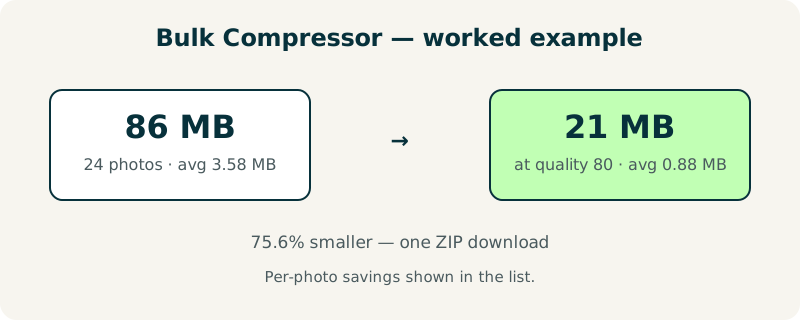
Take a vacation batch of 24 photos totaling 86 MB — an average of 3.58 MB each, since 86 ÷ 24 = 3.58. At quality 80, the batch compresses to about 21 MB total, an average of 0.88 MB per photo, since 21 ÷ 24 = 0.88.
The total saving is 86 MB minus 21 MB, which is 65 MB, and 65 ÷ 86 = 75.6% smaller. One ZIP download collects all 24 compressed photos, ready to upload or email.
Try it with a folder of your own photos: the per-photo list will show you which ones saved the most. Detailed landscapes save less than plain skies, and a photo that was already compressed will show a small saving — the list makes both obvious.
What should I watch for with large batches?
First, memory: very large batches of 50 MB photos can strain a browser tab, so work in groups of 20–30 if you notice slowdowns. Second, mixed content: a batch that mixes photos with screenshots will compress unevenly, because screenshots need palette reduction, not quality reduction — run those separately.
Third, check the worst result, not the average: one photo that saved only 5% may need resizing instead.
For batches that need new dimensions rather than new quality, the Bulk Image Resizer is the matching tool. And if a batch needs an exact size per photo, compress the batch here first, then run the few that are still too big through Compress Image to 100KB.
Frequently asked questions
How many photos can I compress at once?
There is no hard count, but batches of 20–30 photos work best. Each file can be up to 50 MB, and the tool processes them one at a time in your browser so memory stays manageable. If you have a hundred photos, split them into a few groups of 25 — the total time is about the same, and the browser stays responsive while it works.
Are my photos uploaded to a server?
No. Every photo is compressed locally in your browser and never leaves your device. There is no account, no upload queue, and nothing stored after you close the page. That matters for batches, because a batch is often a whole product shoot or a family vacation — far more personal than a single image.
Can I use different quality settings for different photos?
No — the batch uses one quality setting for every photo, which is what makes it fast. If a few photos need special treatment, compress the batch first, then re-run those few individually in the single Image Compressor with a different setting. For most batches, one setting of 80% is right for nearly every photo in it.
What does the ZIP download contain?
The ZIP contains every compressed photo from the batch, each with its original file name, so you can unzip it straight into the folder where the originals live. Photos that failed or were skipped are listed separately and are not included. The ZIP is built locally in your browser, just like the compression itself.
Why did one photo in my batch barely shrink?
A photo that is already heavily compressed — a small JPEG saved from a messaging app, for example — has little detail left to discard, so it may shrink only 5% while its neighbors shrink 50%. The per-photo list shows this honestly. For that photo, shrinking the dimensions with the Bulk Image Resizer will save far more than lowering the quality again.