
Your projected 401(k) balance at retirement — contributions, employer match, and compound growth, at the 2026 IRS limit. Enter your age, salary, contribution rate, employer match, and expected return, and the calculator shows the balance at retirement split into your money, the match, and the growth.
It runs entirely in your browser with no sign-up. The 2026 IRS elective deferral limit is $24,500 a year ($32,500 at age 50 or older, and $35,750 at ages 60 to 63 under the super catch-up), and the tool caps your contribution at that limit automatically. For take-home pay after a 401(k) contribution, see the Paycheck Calculator, and for the tax picture, the Federal Income Tax Calculator.
How to use
- Enter your current age, planned retirement age, and current 401(k) balance.
- Enter your annual salary and the percentage of pay you contribute.
- Enter your employer's match — how much per dollar, and up to what percentage of pay.
- Pick an expected annual return and read the projected balance, split into your money, the match, and growth.
Why use Toolsvine
Retirement calculators elsewhere bury the result behind sign-up forms, and rarely show where the final number comes from. Toolsvine shows the split — your contributions, the employer match, and the growth — with the formula and the 2026 IRS limit visible, so you can see whether the match or the compounding does the heavy lifting, and what one more point of contribution buys.
How does a 401(k) balance grow?
A 401(k) grows from three sources at once: the money you contribute from each paycheck, the money your employer matches, and the investment growth on everything already in the account. The calculator projects it with monthly compounding: FV = B × (1 + r)n + C × ((1 + r)n − 1) ÷ r, where B is your current balance, C is the total monthly contribution (yours plus the match), r is the monthly return, and n is the number of months until retirement.
The employer match deserves attention first, because it is the only guaranteed return in investing: if your employer matches 50 cents per dollar up to 6% of pay, contributing 6% earns an instant 50% return on those dollars before any market growth. The 2026 IRS elective deferral limit is $24,500 for workers under 50 and $32,500 at age 50 or older ($24,500 plus the $8,000 catch-up), or $35,750 at ages 60 to 63 under the super catch-up, and the match does not count against that limit.
Worked example
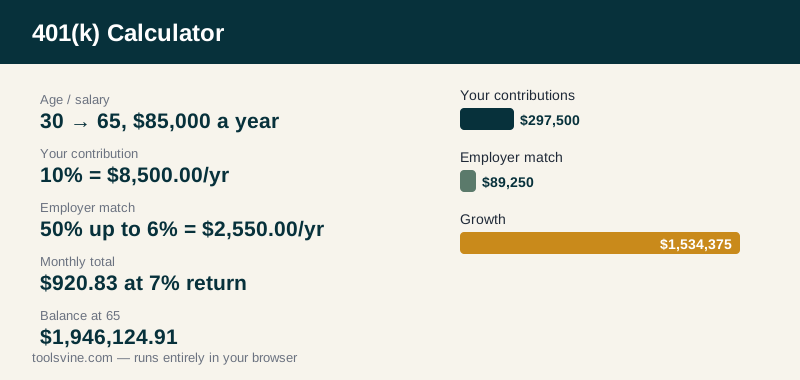
Alex is 30, plans to retire at 65, earns $85,000 a year, has $25,000 in the 401(k), contributes 10% of pay, and the employer matches 50 cents per dollar up to 6% of pay. Alex contributes $8,500.00 a year and the match is 50% of the first $5,100.00, which is $2,550.00 a year — $920.83 a month combined. At a 7% annual return over 35 years, the projected balance at 65 is $1,946,124.91: $297,500.00 of Alex's contributions, $89,250.00 of match, and $1,534,374.91 of growth.
Balance at each milestone
| Age | Balance | Your contributions so far | Match so far |
|---|---|---|---|
| 35 | $101,365.76 | $42,500.00 | $12,750.00 |
| 40 | $209,623.79 | $85,000.00 | $25,500.00 |
| 50 | $580,655.10 | $170,000.00 | $51,000.00 |
| 65 | $1,946,124.91 | $297,500.00 | $89,250.00 |
Growth does most of the work: $1,534,374.91 of the final $1,946,124.91 is investment growth, not contributions. The balance roughly triples between age 50 and 65 — $580,655.10 to $1,946,124.91 — because the compounding base is largest in the final years, which is why starting early beats contributing more later.
How much should I contribute to my 401(k)?
At minimum, contribute enough to get the full employer match — turning down free matching money is the one clear mistake in retirement saving. After that, the usual guidance is 10% to 15% of pay including the match, rising toward the $24,500 IRS limit as your salary grows. The tool caps your contribution at the limit for your age and tells you when it does, so an aggressive percentage never produces a fantasy number.
Remember the projection is a planning estimate, not a promise: it assumes a steady 7% return, no withdrawals, and no change in salary or contribution rate for 35 years. Real markets vary year to year, and the final balance will differ. What the projection does reliably is compare choices — 10% versus 12%, retiring at 65 versus 62 — on identical assumptions, so the better choice is visible. Estimates for planning only — not tax advice.
Frequently asked questions
How much will a 401(k) be worth at retirement?
It depends on your age, salary, contribution rate, match, and return. For example, a 30-year-old earning $85,000, contributing 10%, with a 50% match up to 6% of pay and a 7% return, reaches $1,946,124.91 by age 65. Enter your own numbers above — the tool shows your contributions, the match, and the growth separately.
What is the 401(k) contribution limit for 2026?
The 2026 IRS elective deferral limit is $24,500 a year for workers under 50, and $32,500 at age 50 or older, which adds the $8,000 catch-up. The employer match does not count against that limit. This calculator caps your contribution at the limit for your age and tells you when it does.
Should I contribute enough to get the full employer match?
Yes — always. The match is free money and the only guaranteed return in investing: a 50% match up to 6% of pay turns a $5,100.00 contribution into $7,650.00 before any market growth. Contributing less than the match threshold leaves money on the table every single paycheck, and no investment choice can make up for it.
How much of the final balance is growth versus contributions?
Usually most of it is growth. In the worked example, $1,534,374.91 of the final $1,946,124.91 is investment growth, versus $297,500.00 of the worker's own contributions and $89,250.00 of match. The balance roughly triples between age 50 and 65, because the compounding base is largest in the final years.
What return should I assume for a 401(k) projection?
Many planners use 6% to 8% a year as a long-run planning assumption for a diversified stock-heavy portfolio, and this example uses 7%. No forecast is reliable to a decimal point, so try the calculation at 5%, 7%, and 9% and look at the range. The comparison between choices matters more than any single projected figure.
Is my 401(k) information uploaded anywhere?
No. Your age, salary, balance, contribution rate, and return are processed in your browser and never leave your device. Nothing is uploaded, stored, or shared, and there is no account or sign-up. The calculation uses the 2026 IRS limits from the IRS announcements and the monthly compounding formula shown above.