
How much will a personal loan cost each month — and how much interest will you pay in total? This personal loan calculator uses the standard EMI formula to give the monthly payment, total interest, and total payment for any loan amount, rate, and tenure in years, so the full price of borrowing is visible before you apply.
It runs entirely in your browser with no sign-up. Personal loans are usually unsecured, so their rates run higher than home or car loans — comparing the total interest here is the honest way to shop them. For the general loan formula, see the Loan EMI Calculator, and check take-home pay with the Paycheck Calculator.
How to use
- Enter the personal loan amount.
- Enter the annual interest rate.
- Enter the tenure in years.
- Read the monthly EMI instantly, with total interest and total payment below.
- Open “Show steps” to see the EMI formula worked out.
Why use Toolsvine
Personal loans are the most expensive common borrowing, because there is no collateral behind them — so the interest deserves a hard look before the payment does. This tool shows both together, using the rounded EMI × tenure convention lenders quote, and the interest share is stated plainly rather than hidden inside the monthly figure.
How does a personal loan payment work?
A personal loan is repaid in equal monthly installments — EMIs — that cover both interest and principal. The formula is E = P × r × (1 + r)n ÷ ((1 + r)n − 1), where P is the loan amount, r is the monthly interest rate (annual rate ÷ 12 ÷ 100), and n is the number of monthly payments. The totals use the rounded EMI × tenure, the way lenders quote it.
Personal loans are unsecured — no house or car backs them — so lenders charge more, typically 10% to 20% or higher depending on your credit score. That makes the rate the single most important number: a few points of rate matter far more than a few hundred dollars of loan amount. Some lenders also charge an origination fee taken out of the loan, so check whether the amount you receive matches the amount you are repaying.
Worked example
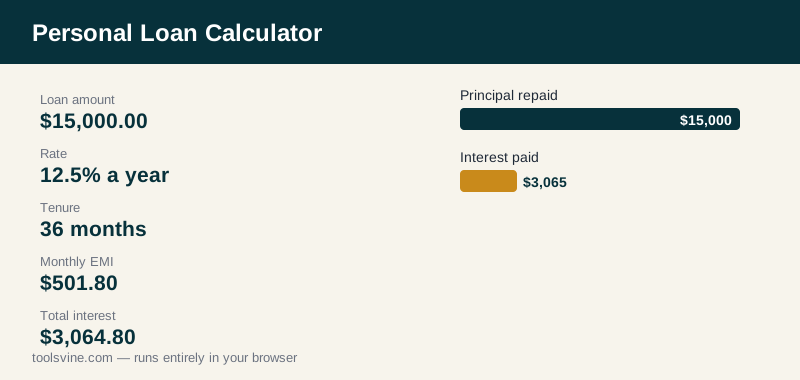
Alex borrows $15,000 at 12.5% for 36 months to consolidate credit card debt. The monthly rate is 12.5 ÷ 12 ÷ 100 = 0.010417, and the EMI is $501.80 a month. Over three years Alex pays $18,064.80 in total — $15,000 of principal plus $3,064.80 of interest, about 20% on top of the loan, which is still far less than carrying the same balance on a card at 24%.
Same $15,000 loan at 12.5% over different terms
| Term | Monthly EMI | Total interest |
|---|---|---|
| 12 months | $1,336.24 | $1,034.88 |
| 24 months | $709.61 | $2,030.64 |
| 36 months | $501.80 | $3,064.80 |
| 48 months | $398.70 | $4,137.60 |
Stretching from 12 to 48 months cuts the payment by $937.54 but quadruples the interest, from $1,034.88 to $4,137.60. For debt consolidation the usual goal is the shortest term you can afford — every extra month is a month of high-rate interest on a balance that is not buying you anything new.
When does a personal loan make sense?
A personal loan makes sense when it replaces more expensive debt or funds a one-time need at a rate you can afford, and when the monthly payment fits your budget with room to spare. Consolidating credit cards at 24% into a loan at 12.5% cuts the interest nearly in half, but only if you stop adding new card debt — otherwise you end up with both the loan and the cards.
It makes less sense for discretionary spending, because you pay 20% extra for something that may not last as long as the loan. Before borrowing, compare at least three lenders on the annual percentage rate, the total interest, and any origination fee. A loan advertised as "no fee" at 15% can cost more than a 13% loan with a 2% fee, and this calculator's total-interest figure is the number that settles that comparison.
Frequently asked questions
How much is the monthly payment on a $15,000 personal loan?
At 12.5% over 36 months, a $15,000 personal loan costs $501.80 a month, for a total of $18,064.80 — $3,064.80 of it interest. A 12-month term costs $1,336.24 a month with only $1,034.88 of interest. Enter your own loan amount, rate, and tenure above for your exact payment.
Why are personal loan rates so high?
Because the loan is unsecured: there is no house or car the lender can take if you stop paying, so the lender charges more to cover the risk. Rates usually run from about 10% to over 20% depending on your credit score and income. A higher credit score is the most reliable way to get a lower rate.
Is a personal loan good for consolidating credit cards?
Often, yes — if the loan rate is well below your card rates and you stop adding new card debt. Consolidating a $15,000 balance from 24% cards into a 12.5% loan saves thousands in interest. But if new spending goes back on the cards, you end up with both the loan payment and card balances, which is worse than where you started.
What is an origination fee, and does it matter?
An origination fee is a charge some lenders take out of the loan before you receive it — often 1% to 5% of the amount. A $15,000 loan with a 3% fee pays out only $14,550 while you repay the full $15,000 plus interest. Compare loans on the annual percentage rate and total interest, not just the advertised rate.
Can I pay a personal loan off early?
Usually, yes, and it saves interest because interest is charged on the balance still owed. An extra payment early, when the balance is highest, cuts the interest on every month that follows. Check your loan agreement first: a few lenders charge a prepayment fee, and some apply extra payments to future installments unless you ask for principal-only.
Is my personal loan information uploaded anywhere?
No. The loan amount, rate, and tenure are processed in your browser and never leave your device. Nothing is uploaded, stored, or shared, and there is no account or sign-up. The calculation uses the standard reducing-balance formula with the rounded EMI × tenure totals lenders quote.