
How much will a deposit actually grow when the interest earns interest of its own? This compound interest calculator applies A = P × (1 + r ÷ n)(n × t) to any principal, rate, time, and compounding frequency — annually, half-yearly, quarterly, monthly, or daily — so you see the maturity value the way a bank calculates it.
It runs entirely in your browser with no sign-up. The result includes the interest earned and the simple-interest comparison, so the compounding effect is a number, not a slogan. For the flat-rate baseline, see the Simple Interest Calculator, and for a fixed-term deposit, the Fixed Deposit (FD) Calculator uses the same formula.
How to use
- Enter the principal amount.
- Enter the annual interest rate.
- Enter the time in years.
- Choose how often interest compounds.
- Read the maturity value instantly, with the interest earned below.
Why use Toolsvine
Compounding is the quiet engine of saving and the quiet cost of borrowing: the same rate can give different results depending on how often it compounds. This tool shows the maturity value for the frequency you choose, plus the simple-interest comparison, so the compounding effect is a number, not a slogan — and you can see what daily versus annual compounding is actually worth.
How does compound interest work?
Compound interest is interest earned on the principal plus the interest already earned, so the balance grows a little faster each period. The formula is A = P × (1 + r ÷ n)(n × t), where P is the principal, r is the annual rate as a decimal, n is how many times a year interest compounds, and t is the years. The interest is the maturity value A minus the principal.
The frequency n is the lever most people overlook. Annual compounding adds interest once a year; monthly compounding adds it twelve times, and each addition starts earning interest right away. The rate and the time are the same in both cases — only the frequency changes — yet the result is different, because interest that arrives earlier has more time to earn its own interest.
Worked example
Jordan invests $10,000 at 5% for 10 years, compounded monthly. The rate per period is 5% ÷ 12 = 0.004167, there are 12 × 10 = 120 periods, and A = 10,000 × (1 + 0.004167)120 = $16,470.09. The interest earned is $16,470.09 − $10,000 = $6,470.09. Simple interest on the same money would be only $5,000.00, so compounding adds $1,470.09.
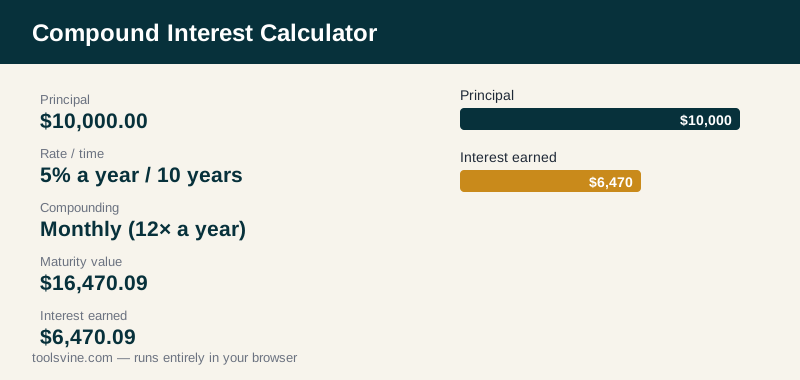
Same $10,000 at 5% for 10 years, by frequency
| Compounding | Maturity value | Interest earned |
|---|---|---|
| Annually | $16,288.95 | $6,288.95 |
| Monthly | $16,470.09 | $6,470.09 |
| Daily | $16,486.65 | $6,486.65 |
Moving from annual to daily compounding adds $197.70 over ten years on $10,000 — real money, but small next to the $1,288.95 that compounding itself adds over simple interest. The lesson is that time and rate dominate: frequency is a fine-tuning knob, not the engine, and starting a year earlier beats compounding daily.
How do I use compound interest to plan savings?
Start with the three numbers that matter most: how much you can put in, the rate you can realistically earn, and how many years the money can stay invested. Enter them here, then change one at a time and watch the maturity value move — doubling the time roughly doubles the interest, while a one-point rate rise compounds into a much bigger difference over twenty years than over five.
Remember that the rate here is a nominal annual rate before tax and inflation, so the real purchasing power will be less than the headline maturity value. Even so, the comparison is honest: the same inputs, the same formula a bank uses, and the simple-interest figure beside it, so you can see exactly what compounding contributes before you commit the money.
Frequently asked questions
What is the compound interest formula?
The formula is A = P × (1 + r ÷ n)^(n × t), where P is the principal, r is the annual rate as a decimal, n is how many times a year interest compounds, and t is the years. The interest earned is A minus P. For example, $10,000 at 5% for 10 years compounded monthly gives A = $16,470.09 and interest of $6,470.09.
How much does $10,000 grow to at 5% over 10 years?
Compounded monthly, $10,000 at 5% grows to $16,470.09 in 10 years, earning $6,470.09 of interest. Compounded annually it grows to $16,288.95, and daily to $16,486.65. Simple interest would give only $15,000.00 — so compounding adds between $1,288.95 and $1,486.65 depending on frequency.
Does compounding more often make a big difference?
It helps, but less than time or rate. On $10,000 at 5% for 10 years, daily compounding beats annual by $197.70, while adding a single percentage point to the rate would add far more. Frequency is worth choosing when it is free — a monthly-compounding account beats an annual one — but starting earlier matters much more.
How is compound interest different from simple interest?
Simple interest is charged only on the original principal, so it is the same amount every year. Compound interest is charged on the principal plus the interest already earned, so it grows each year. On $10,000 at 5% for 10 years, simple interest gives $15,000.00 and monthly compounding gives $16,470.09.
What compounding frequency do banks usually use?
Most US savings accounts and certificates of deposit compound monthly or daily, and the tool defaults to monthly. A fixed-term deposit often compounds quarterly. The page you are on lets you pick annually, half-yearly, quarterly, monthly, or daily, and the result always shows the frequency used, so you can match your bank's terms exactly.
Is my information uploaded anywhere?
No. The principal, rate, time, and compounding frequency are processed in your browser and never leave your device. Nothing is uploaded, stored, or shared, and there is no account or sign-up. The calculation uses the standard compound formula with every step shown.