
What will a fixed deposit be worth at maturity? This FD calculator applies the compound formula A = P × (1 + r ÷ n)(n × t) with the compounding frequency your bank actually uses — quarterly is the usual choice — so the maturity value on screen is the one the bank's own math would give, before tax.
It runs entirely in your browser with no sign-up. In the United States, banks usually call this product a certificate of deposit (CD), and the math is identical: a fixed rate, a fixed term, and compounding at a set frequency. For the same growth with any frequency, see the Compound Interest Calculator, and compare with flat interest on the Simple Interest Calculator.
How to use
- Enter the deposit amount.
- Enter the annual interest rate.
- Enter the tenure in years.
- Choose the compounding frequency (quarterly is the usual FD choice).
- Read the maturity value instantly, with the interest earned below.
Why use Toolsvine
A fixed deposit's headline rate is not its return: quarterly compounding, the tenure, and the rate together decide what comes back. This tool applies the compound formula for the frequency your bank actually uses, so the maturity value on screen is the one the bank's own math would give — before tax — and the monthly-equivalent figure shows what the return works out to per month.
How does a fixed deposit grow?
A fixed deposit locks a lump sum away at a fixed rate for a fixed term, and the interest compounds at a set frequency — usually quarterly for a traditional fixed deposit, monthly or daily for a US certificate of deposit. The formula is A = P × (1 + r ÷ n)(n × t), where P is the deposit, r is the annual rate as a decimal, n is the compounding frequency per year, and t is the years. The interest is A minus P.
Two things decide the result. The first is the rate: a fixed deposit pays more than a savings account because you cannot touch the money until maturity, and the bank pays for that certainty. The second is the frequency: quarterly compounding adds interest four times a year, and each addition starts earning interest right away, so the maturity value is higher than annual compounding at the same rate.
Worked example
Taylor deposits $25,000 at 4.5% for 5 years, compounded quarterly. The rate per period is 4.5% ÷ 4 = 0.01125, there are 4 × 5 = 20 periods, and A = 25,000 × (1 + 0.01125)20 = $31,268.76. The interest earned is $31,268.76 − $25,000 = $6,268.76, a gain of 25.08% over five years — about $521.15 a month if the return were spread evenly, though the money is only paid at maturity.
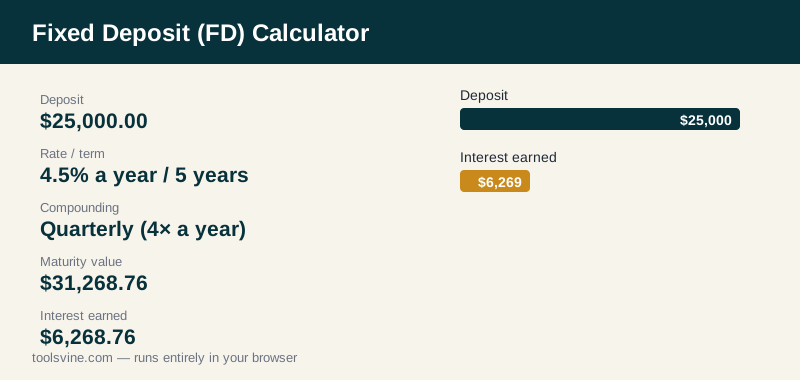
Same $25,000 at 4.5% for 5 years, by frequency
| Compounding | Maturity value | Interest earned |
|---|---|---|
| Annually | $31,154.55 | $6,154.55 |
| Quarterly | $31,268.76 | $6,268.76 |
| Monthly | $31,294.90 | $6,294.90 |
Monthly compounding beats annual by $140.35 over five years on $25,000 — worth having, but small next to the rate itself. A deposit at 5.5% instead of 4.5% would earn roughly $1,500 more over the same five years, which is why shopping three banks for the best rate matters far more than the compounding frequency.
What should I check before opening a fixed deposit?
Check four things: the rate and whether it is fixed for the whole term, the compounding frequency, the early-withdrawal penalty, and whether the interest is taxed in the year it is earned. A long term usually pays a higher rate, but breaking it early can cost several months of interest — so only deposit money you will not need before maturity.
Also check whether the rate is quoted as an annual percentage yield (APY) or a plain annual rate, because APY already includes compounding and will look higher. Laddering helps with the lock-in problem: split the money into deposits maturing in one, two, and three years, so some of it frees up every year while the rest keeps earning the longer-term rate.
Frequently asked questions
What will a $25,000 fixed deposit be worth in 5 years?
At 4.5% compounded quarterly, $25,000 grows to $31,268.76 in 5 years, earning $6,268.76 of interest — a 25.08% gain. Compounded annually the same deposit reaches $31,154.55, and monthly $31,294.90. Enter your own deposit, rate, and tenure above for your exact maturity value.
Is a fixed deposit the same as a CD?
In the United States, the same product is usually called a certificate of deposit (CD): a fixed rate, a fixed term, and compounding at a set frequency. The math is identical — A = P × (1 + r ÷ n)^(n × t) — and this calculator works for either name. Only the label and the early-withdrawal rules differ.
Does compounding frequency change the maturity value much?
A little. On $25,000 at 4.5% for 5 years, monthly compounding gives $31,294.90 versus $31,154.55 annually — a $140.35 difference. The rate matters far more: a one-point higher rate would add roughly $1,500 over the same five years. Pick the best rate first, then take the most frequent compounding offered.
What happens if I withdraw a fixed deposit early?
You usually pay a penalty of several months of interest, and some deposits forfeit all the interest earned. The penalty terms vary by bank and by term length, so check them before you deposit. Only lock away money you will not need before maturity, or split it into a ladder of deposits maturing in different years.
Is the interest on a fixed deposit taxed?
Yes, in the United States the interest is generally taxed as ordinary income in the year it is earned, even if it is not paid out until maturity. The calculator shows the before-tax maturity value. Your bank sends a 1099-INT form, and the exact tax depends on your bracket — the effective return is lower after tax.
Is my deposit information uploaded anywhere?
No. The deposit amount, rate, tenure, and compounding frequency are processed in your browser and never leave your device. Nothing is uploaded, stored, or shared, and there is no account or sign-up. The calculation uses the standard compound formula with every step shown.