
How much interest does a loan or deposit earn when interest is charged only on the original amount? This simple interest calculator applies I = P × R × T ÷ 100 to any principal, rate, and time in years — the same interest every year, with no compounding, so the result is easy to check by hand.
It runs entirely in your browser with no sign-up. Simple interest is the baseline every other method is measured against: use the Compound Interest Calculator to see what the same money earns when interest starts earning interest, and the Percentage Calculator to express the result as a share of the principal.
How to use
- Enter the principal amount.
- Enter the annual interest rate.
- Enter the time in years.
- Read the simple interest instantly, with the total amount below.
- Open “Show steps” to see I = P × R × T ÷ 100 worked out.
Why use Toolsvine
Simple interest is the honest baseline: the same amount every year, charged only on what you started with. This tool shows it plainly, with the yearly interest and the percentage gain, so the gap between simple and compound is visible before you choose a loan or a deposit — and the arithmetic is transparent enough to verify on paper.
What is simple interest, and how is it calculated?
Simple interest is interest charged only on the original principal — never on interest already earned. The formula is I = P × R × T ÷ 100, where P is the principal, R is the annual rate in percent, and T is the time in years, and the total amount is the principal plus the interest. Because the base never changes, the interest is the same in year one and in year ten.
That flatness is what makes simple interest easy to reason about and easy to check. If $10,000 at 5% earns $500 in one year, it earns $500 in every year, so ten years is $5,000 and the total is $15,000. Real bank deposits compound instead, which is why the same $10,000 grows faster elsewhere — but simple interest is still how many short-term loans, late fees, and US Treasury-style calculations are quoted.
Worked example
Alex lends $10,000 at 5% simple interest for 3 years. The interest is I = 10,000 × 5 × 3 ÷ 100 = $1,500.00, which is $500.00 per year, and the total amount is $10,000 + $1,500 = $11,500.00. The interest earned is exactly 15% of the principal — 5% a year for 3 years — and no compounding adds a cent more.
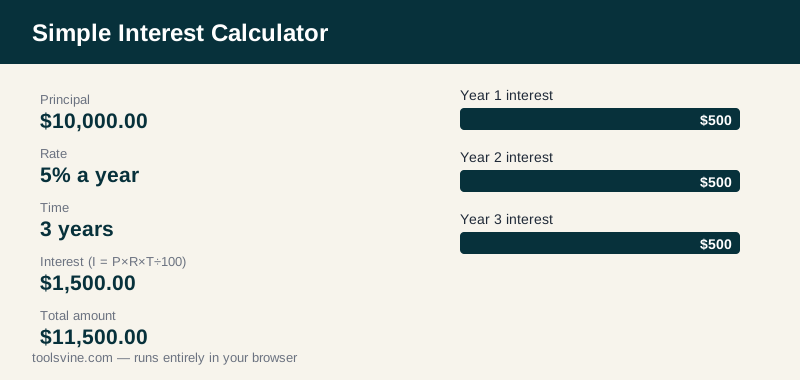
Simple interest on $10,000 at 5% a year
| Time | Interest | Total amount |
|---|---|---|
| 1 year | $500.00 | $10,500.00 |
| 3 years | $1,500.00 | $11,500.00 |
| 5 years | $2,500.00 | $12,500.00 |
| 10 years | $5,000.00 | $15,000.00 |
The interest grows in a straight line: every extra year adds exactly $500.00, because the base never grows. That is the signature of simple interest — and the reason it falls behind compounding over long periods, where each year's interest starts earning interest of its own.
When is simple interest used, and when is compound better?
Simple interest is used for short-term loans, some auto loans, late-payment charges, and simple promissory notes, where the term is short and the flat calculation keeps the paperwork honest. It is also the method taught first in school, because the formula has three inputs and no exponents — a good check that you understand interest before compounding enters the picture.
For saving, compounding is always better, and the gap grows with time: on $10,000 at 5% for 10 years, simple interest gives $15,000.00 while monthly compounding gives $16,470.09 — a $1,470.09 difference from the same rate. For borrowing, the reverse holds: simple interest costs less than compounding over the same period. Either way, knowing the simple figure first tells you exactly what compounding is adding — or costing.
Frequently asked questions
What is the simple interest formula?
The formula is I = P × R × T ÷ 100, where P is the principal, R is the annual interest rate in percent, and T is the time in years. The total amount is the principal plus the interest. For example, $10,000 at 5% for 3 years gives I = 10,000 × 5 × 3 ÷ 100 = $1,500.00, for a total of $11,500.00.
How is simple interest different from compound interest?
Simple interest is charged only on the original principal, so it is the same amount every year. Compound interest is charged on the principal plus the interest already earned, so it grows each year. On $10,000 at 5% for 10 years, simple interest gives $15,000.00 while monthly compounding gives $16,470.09 — a $1,470.09 difference.
How much simple interest does $10,000 earn at 5% for 3 years?
$1,500.00, which is $500.00 per year, for a total amount of $11,500.00. The calculation is 10,000 × 5 × 3 ÷ 100 = 1,500. Because the interest is the same every year, you can check it in your head: 5% of $10,000 is $500, times 3 years is $1,500.
Does simple interest ever change over time?
No. With simple interest the yearly charge is fixed, because it is always calculated on the original principal. Whatever the first year earns, every later year earns the same. That flat line is the hallmark of simple interest — and the reason long-term savers prefer compounding, where the yearly earnings grow.
Where is simple interest used in real life?
Short-term loans, some auto loans, late-payment fees, and simple promissory notes between people often use simple interest, because the term is short and the flat calculation is easy to audit. Many US savings products compound instead. If a loan quote does not say which method it uses, ask — the same rate costs more under compounding.
Is my information uploaded anywhere?
No. The principal, rate, and time are processed in your browser and never leave your device. Nothing is uploaded, stored, or shared, and there is no account or sign-up. The calculation is the standard I = P × R × T ÷ 100 formula, with every step shown so you can verify it yourself.