
What will a car loan cost each month — and how much interest will you pay over the whole loan? This car loan calculator uses the standard EMI formula to give the monthly payment, total interest, and total payment for any loan amount, rate, and tenure in years, so the real price of the car is visible before you buy.
It runs entirely in your browser with no sign-up. Enter the loan amount after your down payment — a trade-in or cash down lowers the loan directly. For the general loan formula with a yearly split, see the Loan EMI Calculator, and plan the cash flow with the Paycheck Calculator.
How to use
- Enter the car loan amount (after any down payment).
- Enter the annual interest rate.
- Enter the tenure in years.
- Read the monthly EMI instantly, with total interest and total payment below.
- Open “Show steps” to see the EMI formula worked out.
Why use Toolsvine
A car's price is not its cost: the interest over the loan can add a fifth to what you pay, and a long tenure can leave you owing more than the car is worth. This tool shows the EMI and the total interest together, using the rounded EMI × tenure convention lenders quote, so the real price is visible before you buy — not after the first year of payments.
How does a car loan payment work?
A car loan is repaid in equal monthly installments — EMIs — that cover both interest and principal. The formula is E = P × r × (1 + r)n ÷ ((1 + r)n − 1), where P is the loan amount after any down payment or trade-in, r is the monthly interest rate (annual rate ÷ 12 ÷ 100), and n is the number of monthly payments. The totals use the rounded EMI × tenure, the way lenders quote it.
Two things make car loans different from home loans. First, the car loses value while you still owe money on it, so a long tenure can leave you "underwater" — owing more than the car is worth — which matters if you need to sell or the car is totaled. Second, dealer financing often bundles the rate with the price, so a lower sticker price with a higher rate can cost more than a higher price with a lower rate.
Worked example
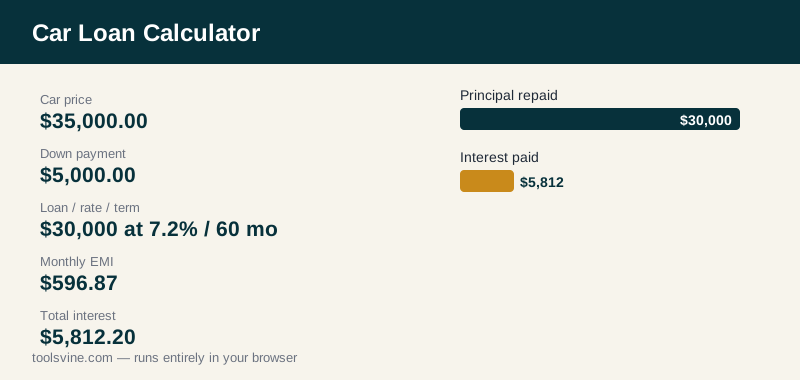
Taylor buys a $35,000 car in Dallas, TX with a $5,000 down payment, leaving a $30,000 loan at 7.2% for 60 months. The monthly rate is 7.2 ÷ 12 ÷ 100 = 0.006, and the EMI is $596.87 a month. Over five years Taylor pays $35,812.20 in total — $30,000 of principal plus $5,812.20 of interest, about 19% on top of the loan.
Same $30,000 loan at 7.2% over different terms
| Term | Monthly EMI | Total interest |
|---|---|---|
| 36 months | $929.06 | $3,446.16 |
| 48 months | $721.17 | $4,616.16 |
| 60 months | $596.87 | $5,812.20 |
| 72 months | $514.36 | $7,033.92 |
Stretching from 36 to 72 months cuts the payment by $414.70 a month but adds $3,587.76 of interest — and six years is a long time to owe money on a car that keeps losing value. A 48-month term is the usual sweet spot: the payment stays manageable while the loan ends before the car needs expensive repairs.
Should I make a bigger down payment on a car?
Yes, whenever you can afford it, because a down payment cuts the loan in three ways at once. It lowers the monthly payment, lowers the total interest, and keeps you from owing more than the car is worth in the first two years, when depreciation is steepest. A $5,000 down payment on a $35,000 car saves $969.00 of interest alone at 7.2% over 60 months, compared with borrowing the full $35,000.
Compare the options before you sign: enter the loan with the down payment, then again without it, and the difference in total interest is the price of borrowing that extra $5,000. Also check the annual percentage rate, not just the monthly payment — dealers can quote a low payment by stretching the term, and the total interest table above shows how expensive that stretch really is.
Frequently asked questions
How much is the monthly payment on a $30,000 car loan?
At 7.2% over 60 months, a $30,000 car loan costs $596.87 a month, for a total of $35,812.20 — $5,812.20 of it interest. A shorter term raises the payment but cuts the interest: 36 months costs $929.06 a month with only $3,446.16 of interest. Enter your own numbers above for your exact figure.
Is a 72-month car loan a bad idea?
Usually, yes. On a $30,000 loan at 7.2%, 72 months costs $7,033.92 in interest versus $3,446.16 over 36 months — more than double — and you keep paying for a car that has lost most of its value. A 48-month term is a better balance for most buyers, and a bigger down payment shortens the risky early years.
What is a good down payment for a car?
Aim for at least 20% for a new car and 10% for a used car, plus any trade-in value. A $5,000 down payment on a $35,000 car leaves a $30,000 loan and saves about $969.00 of interest at 7.2% over 60 months. A bigger down payment also keeps you from owing more than the car is worth.
Does the calculator include tax, title, and fees?
No — the calculator works on the loan amount you enter, which should already be the amount you borrow after tax, title, license, and dealer fees. Add those costs to the car price first, subtract your down payment and trade-in, then enter the result as the loan amount. The monthly payment it shows is principal and interest only.
Can I pay off a car loan early?
Usually, yes, and it saves interest because interest is charged on the balance still owed. An extra payment early, when the balance is highest, cuts the interest on every month that follows. Check your loan agreement first: a few lenders charge a prepayment fee, and some apply extra payments to future payments instead of principal unless you say otherwise.
Is my car loan information uploaded anywhere?
No. The loan amount, rate, and tenure are processed in your browser and never leave your device. Nothing is uploaded, stored, or shared, and there is no account or sign-up. The calculation uses the standard reducing-balance formula with the rounded EMI × tenure totals lenders quote.