
What day of the week was July 4, 1776? Or your birthday in 1990? This free tool finds the weekday for any date — past, present, or future — instantly, with the date shown in full so you can check it at a glance.
It runs entirely in your browser, with no account and nothing uploaded. Use it to plan anniversaries, check historical dates, or settle a bet. To count the days between two dates, use the Date Difference Calculator, and to find your exact age, use the Age Calculator.
How to use
- Enter any date — for example 07/04/1776 or 03/15/1990.
- The tool looks up the weekday for that date using the real calendar.
- Read the full answer: the weekday, the date in words, and the week it falls in.
- Try another date, or check the weekday for a future event you are planning.
Why use Toolsvine
Weekdays are invisible in a date: 07/04/1776 is just numbers until you know it was a Thursday. Calendars only show the present, and mental calendar math is a party trick few people can do. This tool answers in one step, for any date in history or in the future, with no account and no upload.
How can a tool know the weekday of a date in 1776?
Weekdays follow a strict seven-day cycle that has run unbroken for centuries, and the Gregorian calendar defines exactly which dates exist — including leap days. Given a date, the tool counts the days from a known reference point and takes the remainder when divided by 7.
That remainder maps directly to a weekday, and the math is exact for any date the calendar defines.
The calculation is not an estimate. Because the calendar rules are fixed — leap years every four years except most centuries — the weekday of any date is a fact, and the tool computes it the same way your phone's calendar does when you scroll back to 1776.
Famous dates and their weekdays
| Date | Weekday | Event |
|---|---|---|
| 07/04/1776 | Thursday | Declaration of Independence |
| 01/01/2000 | Saturday | Millennium |
| 01/01/2026 | Thursday | New Year's Day 2026 |
| 11/12/2026 | Thursday | Today's example |
Worked example: July 4, 1776 was a Thursday
Enter 07/04/1776 and the tool answers Thursday — the day the Declaration of Independence was adopted. The same method answers nearer dates: 01/01/2026 was a Thursday, and 11/12/2026 is also a Thursday, which you can check against your own calendar.
The consistency is the proof: the seven-day cycle never breaks, so a weekday computed for 1776 is as reliable as one computed for next week.
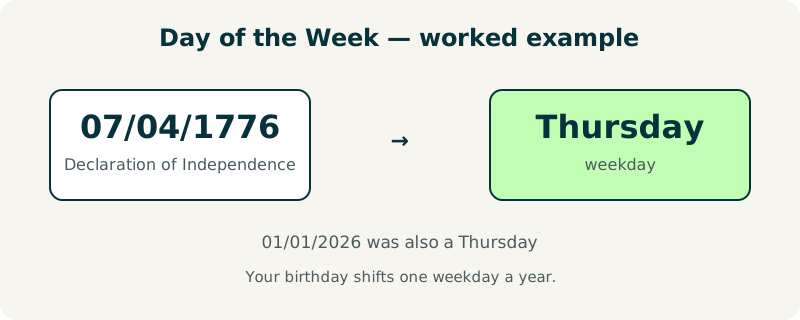
Try it with your own birthday: the weekday you were born on is a small, satisfying fact, and it explains why your birthday lands on a different weekday every year — 365 days is 52 weeks plus 1 day, so each year shifts the weekday by one.
Why does your birthday move weekdays each year?
A normal year has 365 days, which is 52 weeks and 1 day. That extra day pushes every date one weekday forward the next year: a birthday on a Monday this year falls on a Tuesday next year. A leap year has 366 days, or 52 weeks and 2 days.
A birthday after February 29 jumps two weekdays instead of one.
That is also why a birthday returns to the same weekday roughly every 5 or 6 years, not every 7: the leap years in between shift the pattern. The tool makes all of this visible — enter next year's birthday and see the shift. For the gap between two dates, the Date Difference Calculator counts the days, and the Week Number Calculator tells you which week of the year a date falls in.
Frequently asked questions
What day of the week was July 4, 1776?
Thursday. The Declaration of Independence was adopted on Thursday, July 4, 1776. You can verify it with this tool by entering 07/04/1776, or with any calendar app that lets you scroll back that far. The seven-day cycle has run unbroken for centuries, so a weekday computed for 1776 is as reliable as one for next week.
How does the tool know the weekday for such old dates?
It uses the Gregorian calendar rules, which define exactly which dates exist, including leap days. Starting from a known reference date, it counts the days to your date and takes the remainder when divided by 7 — that remainder maps directly to a weekday. The math is exact, and it matches what your phone's calendar shows when you scroll back.
Can I find the weekday for a future date?
Yes. Enter any future date — a wedding, a graduation, a product launch — and the tool tells you the weekday, so you can avoid planning a Saturday event on a Tuesday. Future dates are computed with the same calendar rules, including leap years, so the answer is exact as far into the future as the calendar extends.
Why does my birthday fall on a different weekday every year?
A normal year has 365 days, which is 52 weeks plus 1 day, so every date shifts one weekday forward each year. A leap year has 366 days, or 52 weeks plus 2 days, so dates after February 29 jump two weekdays. That is why your birthday returns to the same weekday roughly every 5 or 6 years, not every 7.
Does this work for dates before 1776?
Yes, for dates in the Gregorian calendar's range. The calendar was adopted in different countries at different times — Britain and its colonies, including America, switched in 1752 — so dates before the local adoption can be ambiguous. For everyday use, any date from the 1700s onward is safe, and modern dates are exact.