
Roll a memorable passphrase from the 7,776-word EFF wordlist: pick four to eight words, a separator, and the generator draws each word with cryptographic randomness, the Diceware way. Easy to remember, hard to crack — and every roll is different.
The words are chosen in your browser and never leave your device. A six-word passphrase carries about 77.5 bits of entropy; compare that with a random string using the Password Generator, or measure a password you already use with the Password Strength Checker.
How to use
- Choose how many words you want — six is the recommended default.
- Pick a separator: spaces, hyphens, or none at all.
- Click Generate passphrase and read the words aloud once to start remembering them.
- Click Copy passphrase and paste it into your password manager or account.
Why use Toolsvine
Random passwords are strong and unmemorable, and unmemorable passwords get written on sticky notes. Diceware solves the trade-off with a simple idea: five dice rolls pick one word from a list of 7,776, and six such words are both easier to remember than sixteen random characters and harder to crack than almost any password a person invents. This generator exists to do the rolling honestly, with real cryptographic randomness instead of a shortcut.
What is a Diceware passphrase?
A Diceware passphrase is a short string of ordinary words, each one chosen at random from a fixed list of 7,776 words — the EFF's large wordlist. Five dice rolls give a number from 11111 to 66666, and that number picks the word.
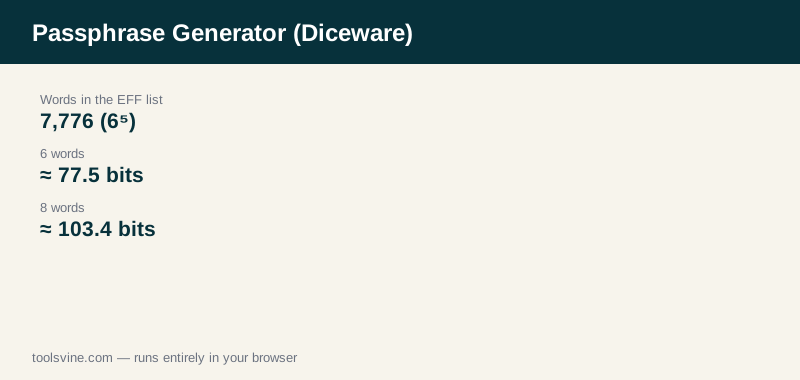
With six words, the number of possible passphrases is 7,776 to the sixth power, or about 77.5 bits of entropy.
Each word adds about 12.9 bits, so the strength grows in clean steps: four words is about 51.7 bits, five is about 64.6, six is about 77.5, seven is about 90.5, and eight is about 103.4. The tool rolls every word with crypto.getRandomValues and shows the entropy for the word count you chose, so the number on screen is the real strength of your passphrase, not a marketing claim.
Worked example
Choose six words with hyphens as the separator and the generator produces something shaped like “maple-river-candle-orbit-velvet-harbor” — six ordinary words, about 77.5 bits of entropy, and readable enough to type from memory after a few uses. Run the same idea through a strength checker and the classic four-word phrase “correct horse battery staple” scores the maximum 4 out of 4, with an offline crack time of centuries at 10,000 guesses a second.
Are passphrases easier to remember than passwords?
Yes, and that is the point. A string of random characters has no structure for your memory to hold onto, while six ordinary words form a small scene you can picture — a maple tree, a river, a candle — and that picture is what makes the passphrase stick after a few days of use.
The trade-off is length: a passphrase is longer to type than a password of the same strength. That matters on a phone keyboard, so keep passphrases for the accounts you type often — your password manager, your email — and let the manager hold random passwords for everything else. Never reuse a passphrase, and never share one: the words are only as secret as you keep them.
Frequently asked questions
Why 7,776 words in the list?
Because 7,776 is 6 to the power of 5 — the number of outcomes from rolling five six-sided dice. Each word is identified by a five-digit number from 11111 to 66666, so five dice rolls pick exactly one word, and every word in the list is equally likely. The EFF list is built from common, distinct words that are easy to spell and remember.
Does the word order matter?
Yes. The passphrase is the words in the order they were drawn, and changing the order makes a different passphrase. The entropy comes from the random choice of words and their order together, so keep the words exactly as generated — reordering them to something that sounds nicer does not help and can cost you the exact string you need to log in.
Can I add a number or a symbol?
You can, and it adds strength — a digit or symbol at the end of a passphrase raises the entropy by a few bits and satisfies sites that demand one. The generator itself only draws words, so add the extra character yourself after copying, and keep it in the same place every time so you remember where it goes.
What separator should I use?
Hyphens are the safest default: they work on every site, they are easy to read aloud, and they keep the words visibly separate. Spaces are just as strong but some sites strip or reject them, and no separator at all makes the phrase harder to read. Pick one separator and use it consistently for that passphrase.
Can I use a passphrase for every account?
You should use a different passphrase or password for every account, so one breach never unlocks the rest. Passphrases are best for the few accounts you type by hand — your password manager and your email — while a password manager holds unique random passwords for everything else, including the sites you rarely log into.