
Add, subtract, multiply, or divide mixed numbers — like 2 1/2 + 1 3/4 — and see every step. This free mixed number calculator converts to improper fractions, works out the answer, simplifies it, and converts it back, so you can follow the math or check homework.
Type two mixed numbers, pick an operation, and the tool gives you the answer as a mixed number, an improper fraction, and a decimal. For single fractions, the Fraction Calculator is the faster tool. To turn a result into a decimal, use the Fraction to Decimal converter.
How to use
- Type the first mixed number, such as 2 1/2.
- Pick an operation: add, subtract, multiply, or divide.
- Type the second mixed number and click Calculate.
- Read the answer as a mixed number with the steps shown.
Why use Toolsvine
Mixed numbers are where fraction arithmetic goes wrong for two reasons at once: the whole part and the fraction part follow different rules, and a carry across the boundary breaks any shortcut. This calculator converts to improper fractions first, does the operation properly, and converts back — printing each conversion — so a student can copy the working and a cook can trust a doubled recipe.
What is a mixed number?
A mixed number is a whole number plus a proper fraction, written together — 2 1/2 means 2 + 1/2, not 2 × 1/2, and 3 2/3 means 3 + 2/3. The fraction part is always smaller than the denominator. Recipes and tape measures use mixed numbers because “1 3/4 cups” is easier to picture than 7/4 cups.
Converting to an improper fraction
Multiply the whole number by the denominator and add the numerator: for 2 1/3, that is 2 × 3 + 1 = 7, so it is 7/3. The reverse is division with a remainder: 11/3 is 3 with a remainder of 2, so it is 3 2/3. Every operation on mixed numbers starts with this conversion, because you cannot add the whole parts and the fraction parts separately when a carry crosses the boundary.
Mixed numbers, improper fractions, and decimals
| Mixed number | Improper fraction | Decimal |
|---|---|---|
| 1 1/2 | 3/2 | 1.5 |
| 2 1/4 | 9/4 | 2.25 |
| 3 2/3 | 11/3 | 3.6667 |
| 4 1/4 | 17/4 | 4.25 |
Notice that 3 2/3 becomes the repeating decimal 3.6667 — the fraction form is exact, while the decimal is rounded. That is why recipes and measurements stay in fractions: 2 2/3 cups is exact, but 2.6667 cups is an approximation that gets worse when you double it.
How do I add mixed numbers?
Convert both mixed numbers to improper fractions, find a common denominator, add, simplify, then convert the answer back to a mixed number. That is four steps, but no shortcut is safe: adding the whole parts and the fraction parts separately works only when the fraction parts do not carry over, and guessing whether they will is how most mistakes happen.
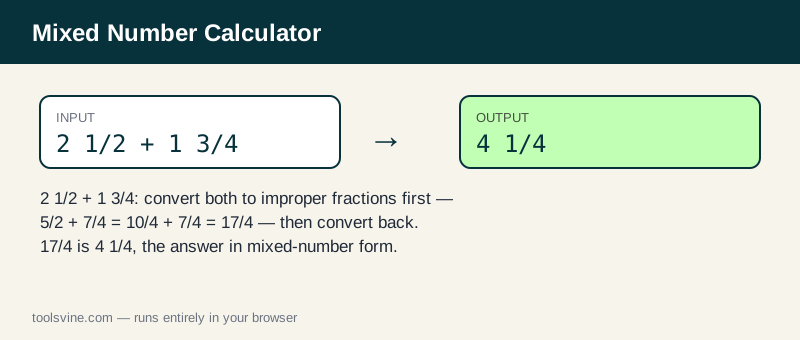
Worked example: 2 1/2 + 1 3/4 = 4 1/4
| Step | Working | Result |
|---|---|---|
| 1. Convert to improper fractions | 2 1/2 = 5/2, 1 3/4 = 7/4 | 5/2 + 7/4 |
| 2. Common denominator | 5/2 = 10/4 | 10/4 + 7/4 |
| 3. Add numerators | 10 + 7 = 17 | 17/4 |
| 4. Convert back | 17 ÷ 4 = 4, remainder 1 | 4 1/4 |
The same method handles the other operations. Subtracting 3 2/3 − 1 1/6 means converting to 11/3 and 7/6, finding the common denominator 6, and getting 22/6 − 7/6 = 15/6, which simplifies to 5/2, or 2 1/2. Multiplying 1 1/2 × 2 2/3 means converting to 3/2 and 8/3, multiplying straight across to 24/6, and simplifying to 4 — a whole number, which the tool still shows as both 4 and 4/1.
When is a mixed number better than a decimal?
When the amount is exact, like a recipe measure or a length in fractions of an inch. Decimals round repeating fractions such as 2/3, so 2 2/3 cups is exact while 2.6667 cups is not, and the error doubles when you double the recipe. Mixed numbers are also easier to read on a tape measure — 2 1/2 inches is one mark past 2, not a number you have to convert in your head.
Frequently asked questions
What is a mixed number?
A whole number plus a proper fraction, such as 1 1/2 or 2 3/4, where the fraction part is always smaller than the denominator. The number 2 1/2 means 2 + 1/2 — not 2 times 1/2. Recipes and tape measures use mixed numbers because “1 3/4 cups” and “2 1/2 inches” are easier to picture than 7/4 cups or 5/2 inches.
How do I convert a mixed number to an improper fraction?
Multiply the whole number by the denominator and add the numerator. For 2 1/3: 2 × 3 + 1 = 7, so it is 7/3. To go back, divide: 11/3 is 3 with a remainder of 2, so it is 3 2/3. The tool shows this conversion in its steps, so you can see the improper fraction it used before doing the operation.
How do I add mixed numbers?
Convert both to improper fractions, find a common denominator, add, simplify, then convert back to a mixed number. For 1 1/2 + 2 1/3 the answer is 3 5/6. Never add the whole parts and the fraction parts separately — that only works when the fractions do not carry over, and guessing whether they will is how most addition mistakes happen.
Can mixed numbers be negative?
Yes — put the minus sign on the whole number, for example −1 1/2, which means −(1 + 1/2). The fraction part itself stays positive. This tool accepts a negative whole number and handles the sign correctly through the conversion: −1 1/2 becomes −3/2, and the answer keeps the sign in the same place.
When is a mixed number better than a decimal?
When the amount is exact, like a recipe measure or a length in fractions of an inch. Decimals round repeating fractions such as 2/3, while 2 2/3 is exact — and the rounding error doubles when you double a recipe. If a measurement is a whole number of sixteenths, the mixed number form also matches the marks on a tape measure exactly.